.svg?width=24&height=24&name=hamburger.svg)
Table of Contents

Share this Article
Your contact center is overwhelmed. Handle times are shooting up, customers are waiting longer, and CSAT is dropping. How people usually think: can’t handle it? Let’s hire more agents.
But what people don’t ask is: are your current agents actually working at full capacity, or are they spending half their day on work that has nothing to do with helping customers?
Because the data says it's the latter.
According to McKinsey, agents spend less than 40% of their time on actual customer conversations. The rest goes in documentation, searching for answers, toggling between tools, and waiting. That's not a headcount problem. That's a workflow problem. And throwing more people at a broken workflow just gives you more people stuck in the same broken workflow.
Before you post that job listing, you need to diagnose ‘busy work’ to improve agent productivity in your call center by maximizing what your current team can do, and only then decide if you actually need more people!
The Hiring Reflex, and Why this Itch Backfires
Every contact center leader has been here. Volume spikes, the team can't keep up, so the request goes in for 20 more agents. It’s almost natural, instinctive.
But think about what actually happens next.
New agents take 4-6 months to hit full productivity (you’re not going to see ROI instantly). During that ramp-up, your best agents get pulled to mentor and shadow, so their output drops too. ICMI research suggests the cost to replace a single contact center agent is between 6-9 months of their salary when you factor in recruiting, training, and lost productivity.
Then there's the seasonal trap. You hire 30 people for the holiday rush. January hits, volume drops, and now you're overstaffed. You either let people go (damaging your employer brand) or carry the cost.
If the reason your team is slow is that they're drowning in manual work, the new hires will drown in it too.
The challenges in the call center industry aren't solved by adding bodies. They're solved by removing the friction those bodies deal with every single day.
Where Agent Time Actually Leaks
Think about an agent's day in three stages: before the call, during the call, and after it. Productivity leaks at every stage, and most leaders only focus on one.
- Before the call: A customer gets routed to a human agent after failing with an IVR or a basic bot. But the agent gets no context. They don't know what the customer already tried, what they asked for, or why the bot couldn't handle it. So the first two minutes of every call is the customer repeating themselves and the agent playing catch-up. Multiply that by just 80 calls a day. That's over two hours wasted on context that should have been passed along automatically.
- During the call: The agent needs to look up a policy, check an order status, or find a refund process. They've got 4-5 tools open: CRM, knowledge base, ticketing system, maybe a spreadsheet someone emailed last week. They put the customer on hold. They search. They can't find it. They ask a colleague on Slack. That's another 3-5 minutes per call of dead time where the customer is just... waiting.
- After the call: Agent writes up a summary. Updates the ticket. Tags the interaction. Logs the outcome. This takes 3-5 minutes per call, and it's completely manual in most centers. That's roughly 20% of an agent's shift spent typing notes that nobody reads unless something goes wrong.
Add it all up: your agents are spending more than half their day on things that aren't helping customers. That's where your call center efficiency is bleeding (not because agents are slow, but because everything around the conversation is slow).
What Changes When AI Handles the Overhead
Now flip each of those stages.
- Before the call: AI routes the call intelligently and passes full context to the agent: what the customer said to the bot, what was attempted, why it was escalated. The agent picks up the call already knowing what's going on. No more "can you repeat your issue."
- During the call: An AI co-pilot listens in real time and surfaces answers the moment the agent needs them. Customer asks about a cancellation policy? It appears on screen before the agent has to search. The co-pilot suggests next-best actions based on the conversation — "this customer qualifies for a retention offer, here's the script." No more hold time. No more tab-switching.
- After the call: AI generates the call summary, updates the CRM, tags the interaction, and logs the resolution — automatically. The agent's wrap-up time goes from 4 minutes to near zero. They're immediately ready for the next call.
At Callpoint AG, a Swiss contact center outsourcer, this kind of AI-assisted workflow reduced agent training time by 60%. New agents were productive in days instead of months because they had AI guiding every call from day one.
This is what it actually looks like to improve agent productivity just by removing everything that was slowing them down.
The Outcomes Your Dashboard Will Show
When agents aren't wasting time on manual overhead, the metrics move fast.
- Average Handle Time drops. Not because agents are rushing customers off the phone, but because the dead time within calls (hold, search, context-switching) disappears. You're cutting the fat, not the conversation.
- First Call Resolution goes up. When agents have the right answer in front of them in real time, they resolve issues on the first try instead of transferring, escalating, or calling back. Forrester consistently links FCR improvements to significant CSAT gains.
- The gap between your best and worst agent shrinks. Your top performer already knows where to find answers quickly. AI levels the playing field — every agent now has that same speed, regardless of tenure. Scaling customer support becomes possible without depending on a handful of star agents.
- Training ROI compresses from months to weeks. When new hires have an AI co-pilot from day one plus AI-powered training simulations with synthetic callers, they reach competence in a fraction of the time. Seasonal hiring stops being a gamble.
And perhaps most importantly: agent productivity gains compound. Every week, agents get more comfortable with the AI tools. Every month, the system learns from more interactions.
The Self-Learning Loop (Where It Gets Compounding)
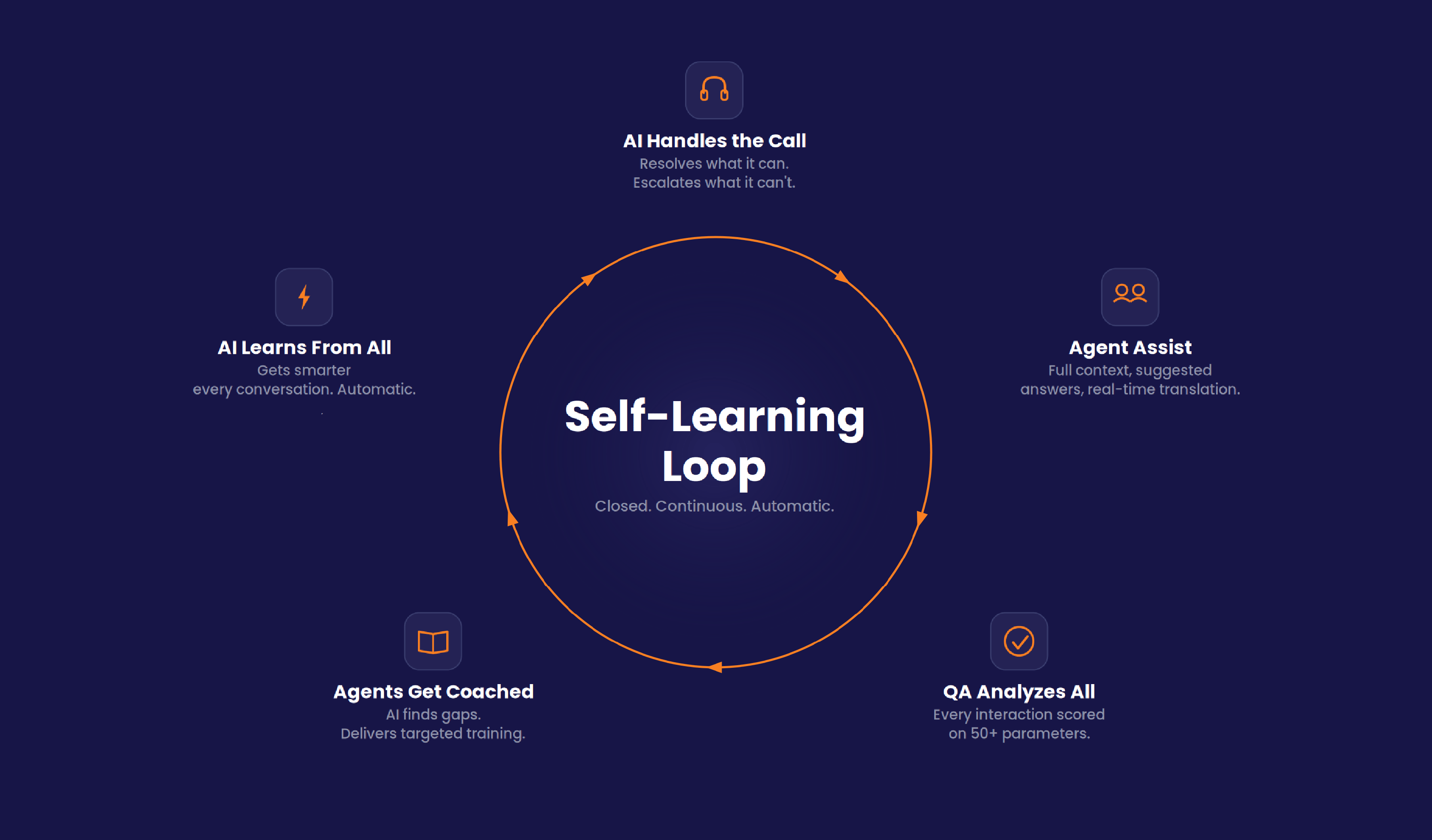
Here's what none of the "10 tips for productivity" blogs will tell you: AI can only be “agentic” when your tools start teaching each other.
Think of it this way. Your AI voice bots and chatbots handle the straightforward stuff — password resets, order tracking, FAQs. That reduces agent volume to only the complex calls. Your Agent Assist helps humans nail those complex calls faster and more accurately. Your QA system analyzes 100% of those interactions (not the 1-3% manual sample most centers do) and spots patterns — which topics agents struggle with, where compliance slips, what questions keep coming up.
Those QA insights feed directly into training. Training becomes targeted, not generic, because you know exactly where each agent needs help. And the training outcomes feed back into the bots — the questions agents now handle well get automated next, freeing them for even higher-value work.
This is what an agentic, self-learning contact center looks like. Every layer makes every other layer smarter. Productivity in customer service doesn't just improve once — it compounds month over month without anyone manually orchestrating it.
Now (and Only Now) Decide If You Need More People
Once every agent has real-time AI assist, automated after-call work, instant knowledge surfacing, and 100% QA running in the background — you'll know for the first time whether you actually need to hire.
Because now you have data. You can see: are agents at capacity on complex calls even with all the automation? Are there specific shifts or languages where you're genuinely short? Is wait time still over threshold despite maximum efficiency?
If the answer is yes — hire. But now onboarding takes weeks instead of months. The new agents ramp fast because the AI infrastructure is already there. You're not gambling. You're making a calculated, data-backed investment.
And if the answer is no? You just saved yourself 6-9 months of salary per agent you didn't need to hire. That's not a small number.
Start With What You Have
The biggest productivity gains don't come from more people. They come from removing the friction your current people deal with 80 times a day.
Three moves: eliminate the manual work before, during, and after every call. Give agents an AI co-pilot so they never have to search for an answer again. Build a self-learning system where every interaction makes the next one faster.
Want to know where your agents are leaking time?
Book a free productivity gap analysis with Enterprise Bot.
Check out our ROI calculator if you want a ballpark estimate of what you’ll save!
.png?width=352&name=Blog%20Headers%20(4).png)


-1.svg)
-1.svg)
-1.svg)