Table of Contents
Share this Article
How Europe is legislating better customer service while CX teams keep betting bigger on AI.
CX AI is booming, and it is being tested on your customers
If you run a contact centre, you already know where the budget is going. It is going into AI, and it is not slowing down. The market for conversational AI is worth around 18 billion dollars in 2026 and is growing more than 20 percent a year. Inside service teams the shift is sharper still. Gartner found that AI spending rose 38 percent in a year while overall service budgets grew just 2 percent, and two in three teams now run some form of agentic AI, up from fewer than four in ten a year ago.
The promise is real. Older bots could only answer questions. The newer agentic systems can actually resolve a request, as long as you connect them to your systems and let them act. But a lot of this went live before it was ready. When a half-built bot cannot resolve the issue and will not let the customer leave, the cost does not disappear. It moves onto the customer.
The data is blunt. In a 2026 survey of more than a thousand consumers, the top complaint about service was talking to a bot that does not understand them. More than half said they have deliberately worked around a chatbot to reach a person, and one in three would switch brands rather than go through it again. For a few years this was a quiet trade, because the savings showed up on your dashboard while the frustration showed up on the customer. That trade is now becoming a legal one.
Europe is turning the right to a human into law
Start with something easy to miss. The right to reach a human is not new. Since 2018, Article 22 of the GDPR has given people the right to human intervention when a decision about them is made by software alone, with no person involved. What is changing now is that this principle is being extended, made specific for customer service, and given hard dates.
Over about ten weeks, a cluster of European rules takes effect, and they all protect the same thing. They protect the customer's route back to a person.
- 28 October, Poland. The country's new AI regulator opened for complaints, including complaints about AI used by banks, insurers, and healthcare providers.
- 20 November, the EU. A new consumer credit rule gives anyone rejected by an automated system the right to a human review and a clear explanation. It applies across member states, including Germany, Austria, Sweden, Denmark, and Finland.
- 28 December, Spain. The customer service law known as Ley SAC takes full effect. It requires a human on request, it requires 95 percent of calls to be answered within three minutes, and it bans bot-only support outright.
Underneath all of this runs the EU AI Act. Since August it has required one basic thing, that you tell people when they are dealing with a machine, and for higher-risk uses it requires real human oversight rather than a rubber stamp.
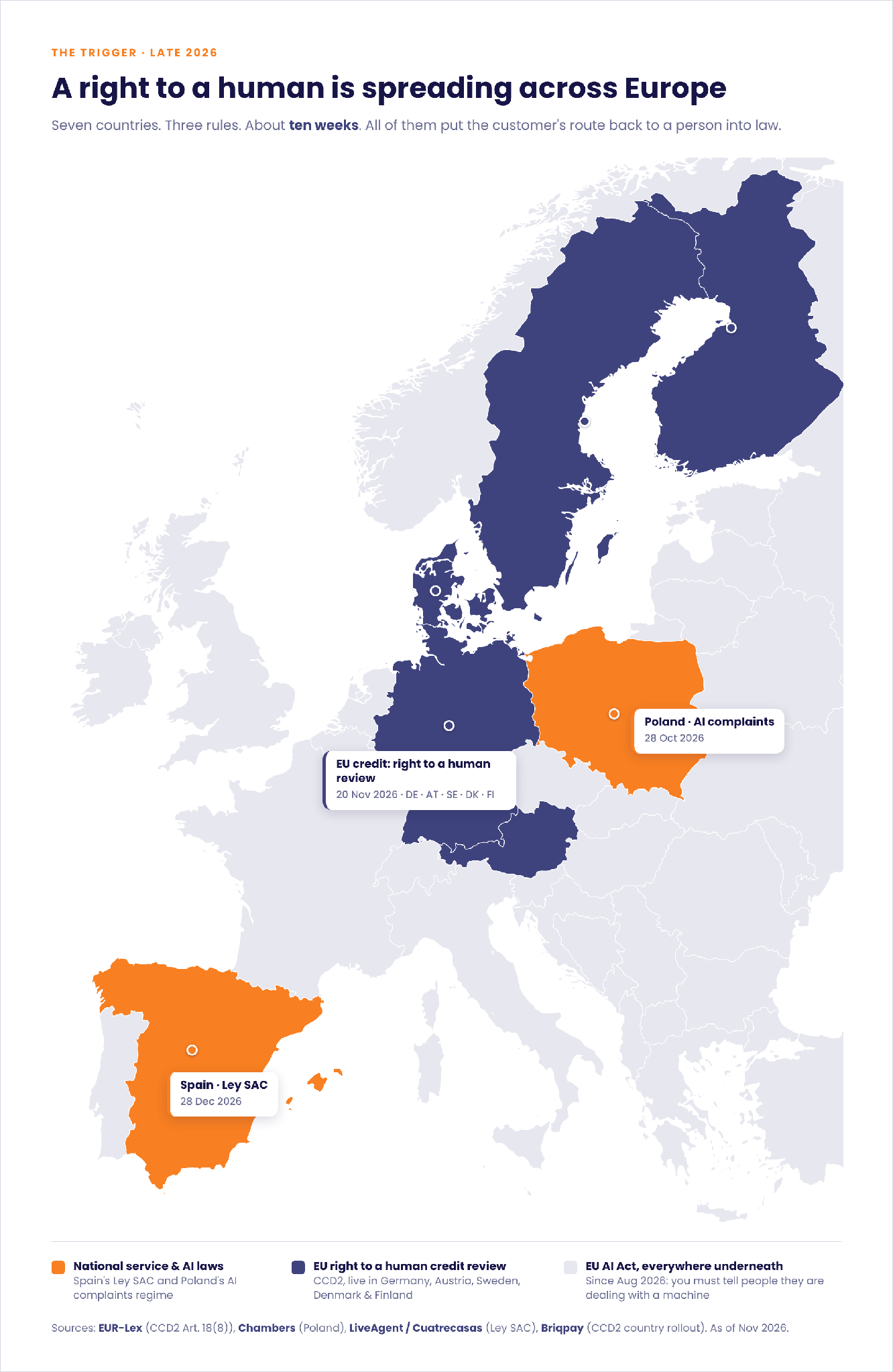
For contact centre ops, none of this is abstract. These are hard dates with real obligations, and they land across the exact European markets most of you serve, at the same time.
And the net is still widening. On 11 November, the European Commission proposed the Digital Fairness Act, which would give consumers across the EU a clear right to reach a human in customer service, not only in credit decisions or only in Spain. It is a proposal for now, and it still has to pass. But the direction is one way. A patchwork of national rules is heading toward a single EU-wide one.
Meeting this is harder than it looks
The obvious response is to put more people back in. If customers have a right to a human, hire more agents. But that answer runs into three walls fast.
The first is cost and coverage. Hitting a target like 95 percent of calls answered in three minutes, across every channel, is expensive to staff. Do it across Europe and it gets harder, because the right to a human is not a right to a human who happens to speak English. You need native-language agents for German, Spanish, Polish, the Nordic languages, and more, each with their own volumes and peak hours. Planning your workforce around that, language by language and channel by channel, is a real problem, not a line item.
The second wall is that the AI you already have was not built to take this load off you. Most deployments were tuned for deflection, to contain contacts rather than resolve them. They often do not hand off to an agent with the full conversation attached, so the customer repeats everything. They rarely hold the same standard across voice, chat, and email. And they are usually strong in English and weaker in every other language. So the channel that was meant to absorb demand often just pushes it back, now with a clock attached.
The third wall is that these two problems collide. Demand for human access is going up and getting a deadline, while the AI meant to reduce that demand is not resolving enough to help. You cannot simply hire your way out, and you cannot lean on bots that only deflect. Something in the middle has to change.
The way through is to make what you already have work together
The good news is that the fix is usually not a rip and replace. It is making your existing channels actually resolve, and escalate cleanly when they cannot. That starts with seeing clearly where you stand today.
First, diagnose channel by channel. Where does your voice AI fail, and in which languages? Where does chat stall? Which customer journeys resolve on their own, and which always end in a frustrated transfer? This is where Voice AI and Conversational AI insights earn their place. You cannot fix a containment problem you cannot see, and most teams are flying blind on which channel drops which contact.
Then connect what you have. Most contact centres are running a voice bot in one place, a chat bot in another, an IVR, a knowledge base, and a CRM that barely talk to each other. Pulled into one platform, the AI can resolve more on its own, and when it does hand off, it can pass the whole conversation to an agent so nobody starts over. One platform also means one standard across voice and chat, and across every language, instead of a setup that is strong in English and weak everywhere else.
This is exactly what Enterprise Bot is built to do, and three parts of the platform carry it.
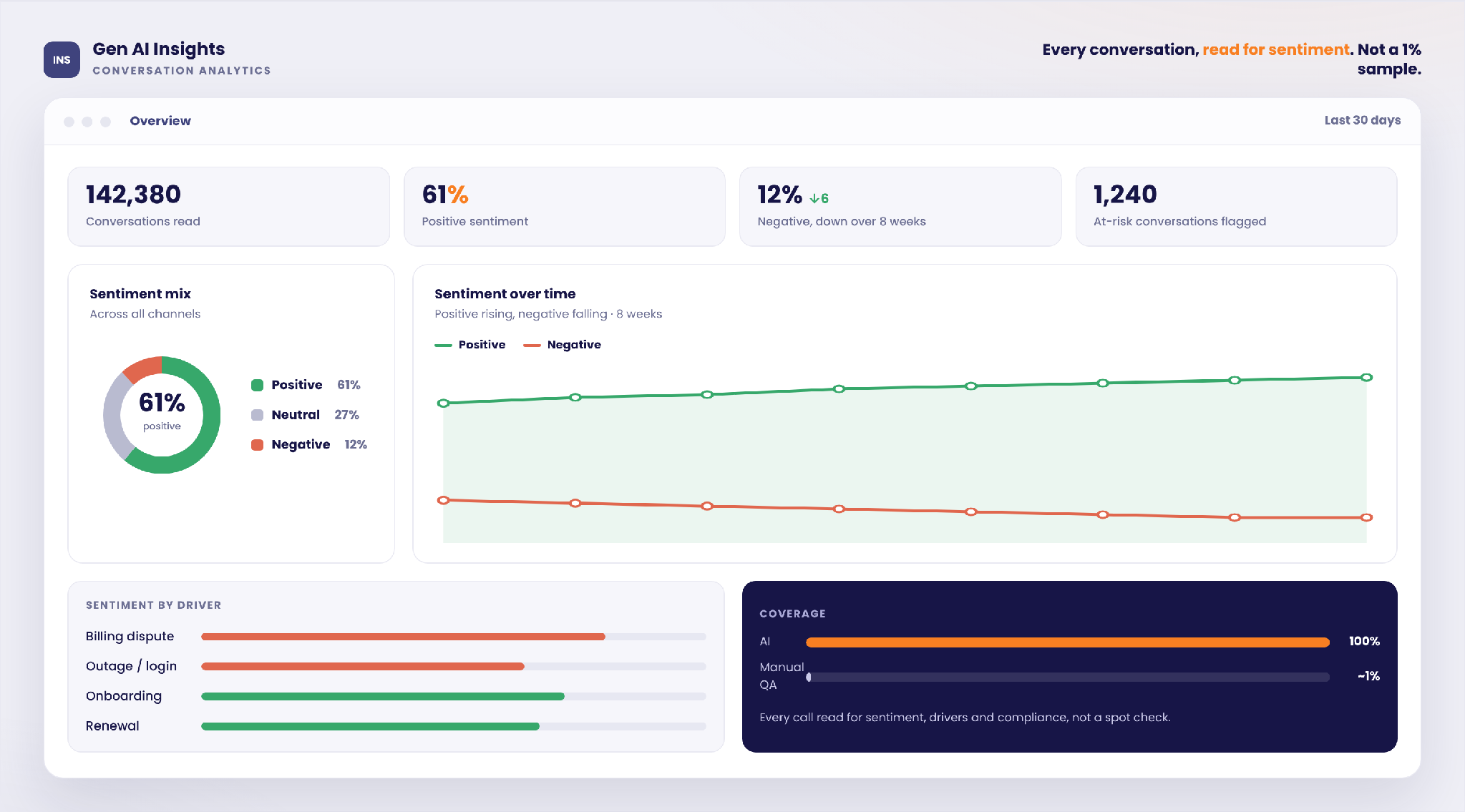
Gen AI Insights: see where you actually stand. It reads 100 percent of your conversations, not a 1 percent sample, and scores each one for sentiment, the driver behind it, and compliance. You find out which channels and which languages resolve, and which ones quietly leak customers, so you fix the real gaps instead of guessing.
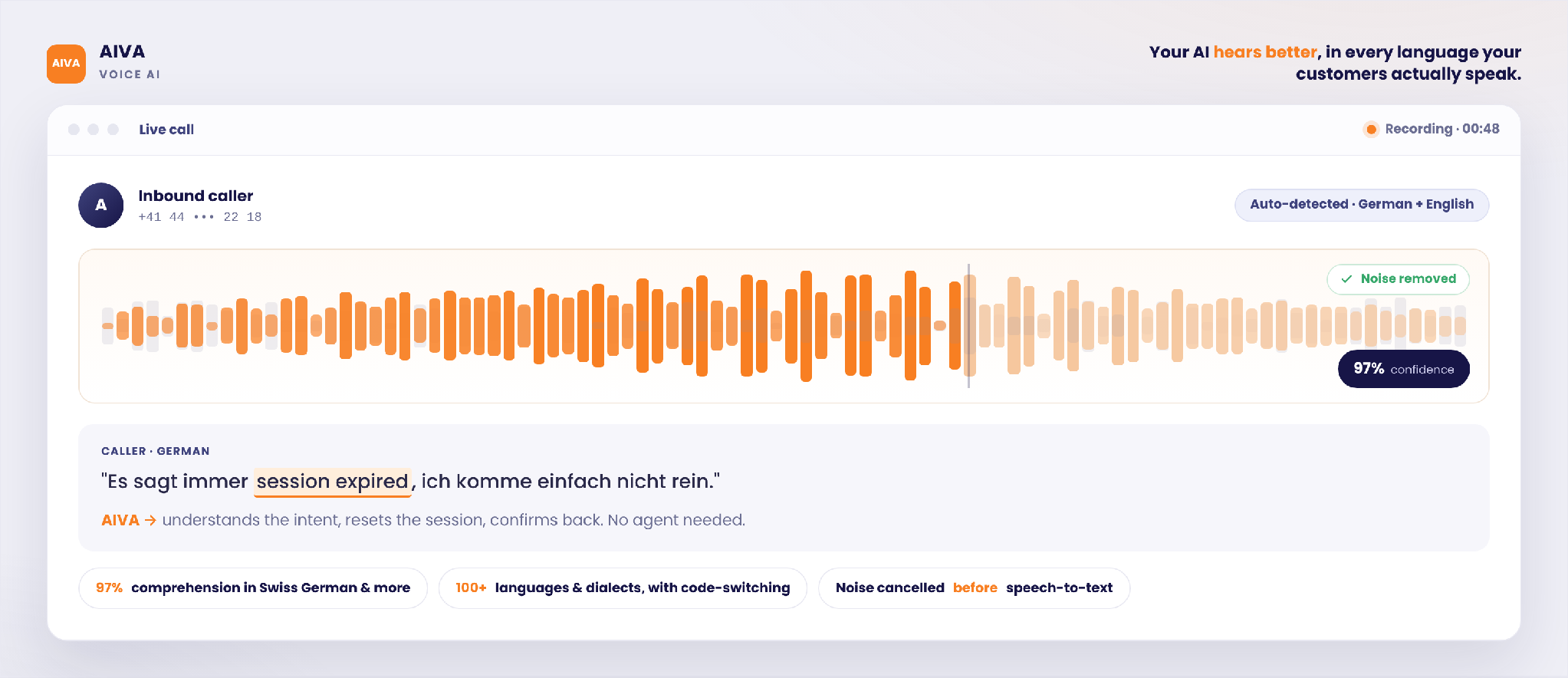
AIVA: voice that hears better. AIVA cleans the audio before it reaches speech-to-text, so background noise and strong accents stop breaking the transcript. It understands Swiss German and more at around 97 percent, and it handles over 100 languages and dialects in one bot, switching between them mid-sentence. The result is a voice channel that resolves far more on its own, in the languages your customers actually use.
AIDA: connect your stack and resolve. AIDA is the agentic layer. It plugs into the systems you already run, your CRM, ticketing, knowledge base, and core policy and billing systems, and it acts in them. So a request like changing an address and sending the confirmation gets done end to end, and when a human is needed, AIDA hands over the whole conversation so nobody has to start again.
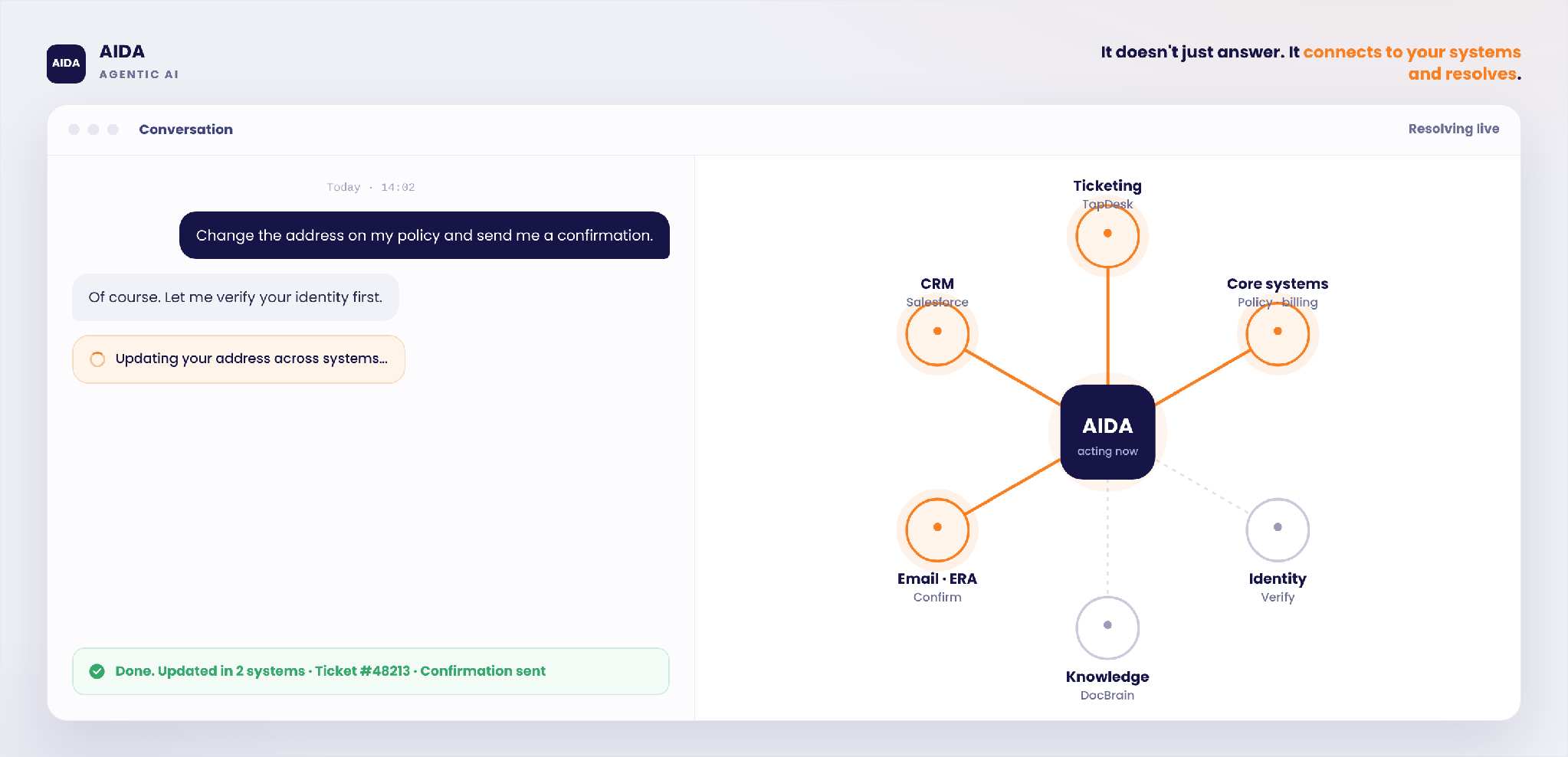
Put together, this is the platform the last few paragraphs described. One system that resolves more, escalates cleanly, and holds the same standard across every channel and every market you serve.
Where this is headed
Step back and the direction is clear. For a decade, customer service AI was judged on how many people it kept away from an agent. That era is ending. Regulation is pushing it, but customers were already there. They do not want fewer bots or more bots. They want their problem solved, and a person when it is not.
The law is only going to make this firmer. Spain, Poland, and the EU credit rules are live now. The Digital Fairness Act points to an EU-wide right to a human not far behind. So the question is no longer whether you offer a real route to a person. It is whether your AI is good enough that most people never need to use it.
The teams that come out ahead will not be the ones that bought the most AI or hired the most agents. They will be the ones that made their channels work together, with AI that resolves, humans where they matter, and the same standard in every language. Voice AI and Conversational AI stop being experiments you run on your customers and start being the infrastructure your service runs on.
That shift is already underway, and the next ten weeks will show who was ready. If you want to see where your own channels resolve and where they leak, that is exactly the kind of diagnosis we help with, and we are happy to take a look.
Sources
- Conversational AI market size and growth: Fortune Business Insights via Azumo
- AI service spending up 38% vs 2% budget growth: Gartner
- Customer dissatisfaction and workaround behaviour: Parloa Consumer Patience Index 2026
- GDPR Article 22, right to human intervention on automated decisions: EUR-Lex
- Spain Ley SAC: LiveAgent, Cuatrecasas
- Poland AI complaints (KRiBSI), 28 Oct: Chambers
- EU credit right to human review (CCD2, Art. 18(8)), 20 Nov: EUR-Lex; country rollout: Briqpay
- EU AI Act disclosure and human oversight: Extentum
- EU Digital Fairness Act, proposed 11 Nov 2026, incl. a right to reach a human in customer service: Tech Journal
- Pranay Jain quote: EM360 podcast (verbatim)